


LLNL is home to several computing-centric Centers and Institutes that provide a mechanism and organizational structure for collective, multidisciplinary research activities. These entities offer an access point for collaboration with the academic community and an avenue for strategic partners to access LLNL capabilities, facilities, and vast intellectual capital. Explore some of our computing-focused Centers and Institutes below.

Center for Applied Scientific Computing
CASC serves as LLNL’s window to the broader computer science, computational physics, applied math, and data science research communities. Collaborating with academic, industrial, and government partners, we conduct world-class scientific R&D on problems critical to national security.
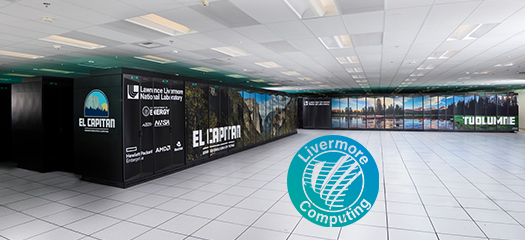
Livermore Computing
With world-class leadership and experience, Livermore Computing (LC) is home to the computational infrastructure that supports the advancement of HPC capabilities. We harness advanced computing power through scalable, cost-effective, specialized environments—from hardware and software to buildings, facilities, and user support.
Data Science Institute
Data science has become an essential discipline paving the path of LLNL's key program areas, and the Lab is home to some of the largest, most unique, and most interesting data and supercomputers in the world. The Data Science Institute (DSI) acts as the central hub for all data science activity at LLNL.
High Performance Computing Innovation Center
The HPC Innovation Center (HPCIC) is an LLNL initiative that pursues outreach and collaboration opportunities through accessible software, technologies, and resources. Our computational facilities and data center operations are world-class and have been operating for several decades.
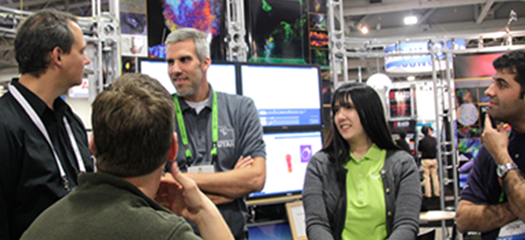
Academic Engagement Program
The CASC Academic Engagement Program (AEP) facilitates outreach for the Computing directorate with the academic research community. The program helps staff collaborate with faculty and other researchers through joint research, subcontracts, faculty visits, and sabbatical arrangements.
Advanced Simulation and Computing Program
The ASC Program integrates the work of Lawrence Livermore, Los Alamos, and Sandia national labs with university researchers into a coordinated program administered by NNSA. Under ASC, computer simulations analyze and predict the performance, safety, and reliability of nuclear weapons.
Genesis Mission
Genesis Mission will develop an integrated platform that connects the world's best supercomputers, experimental facilities, SI systems, and unique datasets across every major scientific domain to double the productivity and impact of American research and innovation within a decade.

High Performance for Energy Innovation (HPC4EI)
DOE's multi-Lab HPC4EI program is a government partnership with industry that leverages our complex-wide world-class computational resources to advance the national energy agenda.
High Performance Software Foundation
Co-founded with the Linux Foundation, the nonprofit HPSF is a neutral hub that supports projects advancing portable, open-source software for diverse hardware. By increasing adoption, aiding community growth, and enabling development efforts, HPSF lowers barriers to use of HPC systems.

Multiprogrammatic and Institutional Computing (M&IC) Program
The Laboratory's M&IC Program brings tailored, cost-effective classified and unclassified computing services to LLNL programs and scientists. It grants access to Livermore Computing resources through both institutional and project funding.

Predictive Science Academic Alliance Program
The Predictive Science Academic Alliance Program (PSAAP) is the primary mechanism by which the NNSA’s ASC program engages the U.S. academic community in advancing science-based modeling and simulation. The program selects both Predictive Simulation Centers and Focused Investigatory Centers to utilize NNSA HPC resources.