


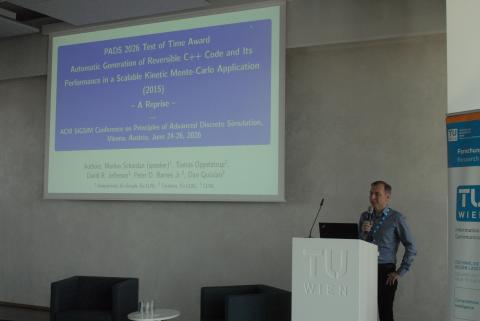
A team of Lawrence Livermore National Laboratory (LLNL) researchers has received the 2026 Test of Time Award from the ACM SIGSIM Principles of Advanced Discrete Simulation (PADS) conference for their paper, “Automatic Generation of Reversible C++ Code and Its Performance in a Scalable Kinetic Monte-Carlo Application.”
PADS honors up to two papers each year—one from the conference held 10 years prior and another from 20 years prior.
LLNL’s winning paper was presented at PADS 2016 and introduced Backstroke, a software build tool that automatically generates code needed to undo, or roll back, calculations in a parallel-discrete-event computer simulation using optimistic synchronization. The paper’s authors are Markus Schordan (formerly of LLNL), Tomas Oppelstrup, David Jefferson (LLNL retiree), Daniel Quinlan, and Peter D. Barnes Jr.
Optimistic synchronization allows parallel simulations to proceed without waiting for all potential time ordering conflicts to be resolved. When a conflict is later detected, the affected computation must be rolled back to before the conflict took place. Before Backstroke, implementing this capability was a manual, error-prone programming task.
Backstroke transformed rollback support into an automated part of the software build process and supported programs written in both C and C++. Enabled by the ROSE compiler toolkit, the system automatically generated reversible code and demonstrated its performance in a scalable kinetic Monte Carlo application.
Quinlan has led the ROSE project for more than 30 years and has seen its impact on several LLNL initiatives, including Backstroke: “Backstroke showed how ROSE’s program-analysis and transformation capabilities could solve a concrete and difficult problem: automatically generating the code needed to reverse computations in real C++ applications. This award is especially meaningful because it recognizes the lasting importance of Backstroke’s contribution to scalable parallel simulation.”
Backstroke became foundational for subsequent research on parallel discrete-event simulation by removing a major programming obstacle to optimistic execution. The research eventually led to a three-part series on Unified Virtual Time (UVT) that was published in the ACM Transactions on Modeling and Computer Simulation. UVT unified static conservative and optimistic approaches into a dynamic framework for parallel simulation.
The award was presented at PADS 2026, which was held in Vienna, Austria, in June, and was the 40th anniversary of the conference. As part of the recognition, the authors presented an invited talk about the paper’s impact and its continuing relevance to simulation research.
—Deanna Willis