


Previous: Advancing discovery, shaping the future
LLNL’s Center for Applied Scientific Computing (CASC) has reached a milestone: 30 years of technical expertise, collaboration, and service in applied mathematics, computer science, and data science. Since joining as a postdoctoral researcher in 2010, CASC director Kathryn Mohror has come to appreciate her peers’ experience and scientific contributions. “CASC people are driven to seek out challenging problems. They truly are the best and brightest from all over the world,” she says.
Parts of the Sum
This excellence is reflected in the staff’s many accomplishments. CASC research is widely recognized nationally and internationally. The awards continue to stack up, including Gordon Bell Prize winners and finalists, R&D 100 Award winners and finalists, Department of Energy (DOE) Early Career Research Program awards, and a hefty list of Best Paper awards in numerous publications and conferences. Journal publications also accumulate rapidly, with 2025 being a typical year of more than 350 credits. The Center’s researchers write books, participate in international competitions, conduct peer reviews, release open-source software, secure patents, and co-author multi-institutional technical reports.
CASC’s current roster includes 10 Distinguished Members of Technical Staff, the Laboratory’s highest technical job classification recognizing exceptional scientific achievements. Over the years, three researchers have won the prestigious U.S. Presidential Early Career Award for Scientists and Engineers.
Recognition and leadership often go hand in hand. Many staff members belong to professional societies, including several fellows of the Association for Computing Machinery, the Institute of Electrical and Electronics Engineers (IEEE), and the Society for Industrial and Applied Mathematics (SIAM). CASC staff have also been named as IEEE senior members, while mathematician Carol Woodward serves as SIAM president.
CASC managers encourage conference participation and professional service, resulting in year-round paper and poster acceptances, session chairing, workshop and tutorial organization, and committee appointments. For example, Mohror will serve as general chair of the 2027 International Conference for High Performance Computing, Networking, Storage and Analysis—the world’s largest high-performance computing (HPC) conference. Other CASC members volunteer at all levels of conference committees, helping shape technical communities.
A catalog of CASC staff’s individual accomplishments nevertheless reveals a common thread of teamwork. Co-authors and co-presenters often hail from other organizations within the Laboratory as well as from universities, industry partners, and national laboratories.
Career Liftoff
Accolades are one result of CASC’s investment in people, while staff at every career stage benefit from the Center’s rich tradition of professional growth. For many, an internship or postdoctoral appointment was the first step toward a long-term CASC career. Deputy director Tom Epperly confirms, “Many of us feel a responsibility to pass knowledge to the next generation. We are actively involved in shaping students and postdocs as future hires.”
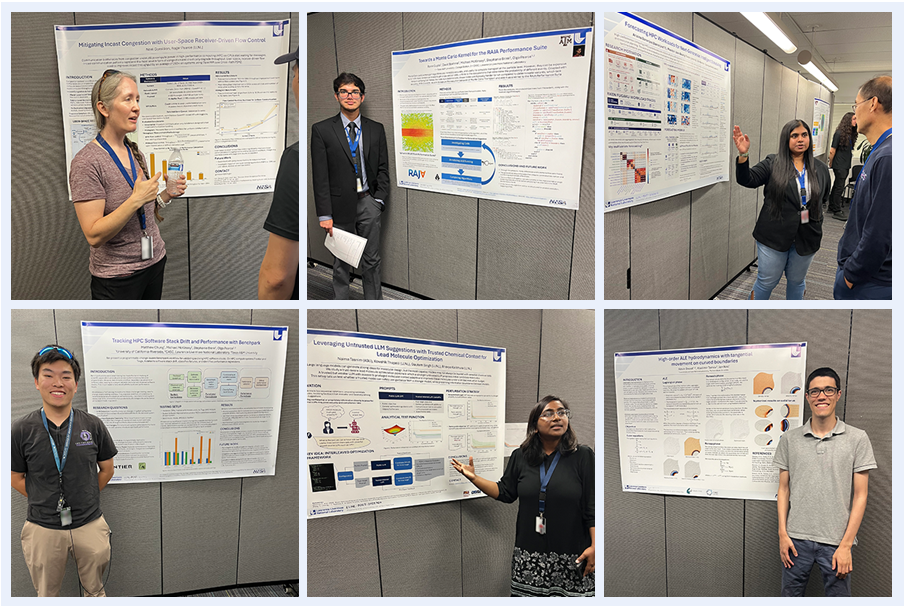
This year the Center hosted 75 summer interns, some of whom may ultimately join CASC full time. Computer scientist Mina Priest progressed from intern to postdoc, then staff scientist, and now group leader. “The internship provided the runway to gain new skills and explore interesting research, and the experience inspired me to apply for a postdoc appointment,” she explains. “My original plan was to find a tenure-track position in academia. But at CASC, I stepped outside my specialty and interacted with multidisciplinary teams. The environment convinced me I had a future here.”
Since then, Priest’s research portfolio has continued to expand alongside leadership and mentoring opportunities. For example, she now leads CASC’s Graph Science and Irregular Computing group as well as the Data Science Summer Institute. “I want to help interns maximize their experience. They need exposure to people and projects outside their immediate circle, so we’re expanding their access and helping them network with others,” notes Priest.
Postdoc positions offer another entry point into CASC. Jeffrey Hittinger, former director (2018–2025) and now Computing’s deputy associate director for science and technology, joined the Center’s postdocs in 2000. “I arrived with no intention of staying but forgot to leave because I was having too much fun,” he recalls. “There are always interesting problems to work on, and people can reinvent themselves with new challenges.”
Most of Computing’s postdocs are based at the Center where advancement opportunities are abundant. Computer scientist Ming Jiang interned at LLNL in 2002, joined CASC as a postdoc in 2005, and became a staff scientist in 2008. “I truly valued my postdoc experience. I wanted to stay because CASC appreciated my work and allowed me to grow,” he shares. CASC also supports postdoc development via the Fernbach Fellowship and by hosting Livermore Graduate Scholar Fellows and DOE Computational Science Graduate Fellows.
For Kathleen Schmidt, who transferred from another LLNL organization to lead the Uncertainty Quantification (UQ) and Optimization group, mentoring students and postdocs supports future talent while increasing research productivity. She states, “Investing in others as they grow in their careers can help projects succeed.”
The Center is also committed to nurturing other roles, such as project and group leaders. “CASC’s approach to staff development is special. It pays attention to creating a highly skilled, motivated workforce who reach their professional goals,” says Hittinger. The investment includes access to training, which Schmidt appreciates. She states, “CASC cares about both technical and soft skills. Some of my group members have learned Spark, Python, Git, and advanced coding techniques on the job.” CASC’s educational values extend outward: For instance, computational mathematician Andrew Gillette leads a Laboratory-wide artificial intelligence and machine learning training program.
Focused Groups
These and other career paths mature within CASC’s 12 groups, each of which has unique disciplines and strengths. “Our research expertise spans the broad areas of computer science, data science, applied mathematics, and computational science, roughly balanced across the groups,” notes Mohror. (Read more about mission impact in the companion article CASC at 30: Advancing discovery, shaping the future.)
The number of groups and their emphases have shifted over time to reflect research priorities, while, Epperly adds, “Some groups have always existed as throughlines of mission support.” Two groups have been added since 2023, in part because CASC keeps growing. This year, the High Performance Computing group was renamed Software Analysis and Transformation to better represent dedication to HPC compilers, formal methods, abstractions, and programming models.
Distinct research interests can coexist within an evolving group. Created in 2020, the UQ and Optimization group investigates statistical inference, numerical optimization, quantum control, and uncertainty in complex systems. Schmidt says, “This expertise is needed throughout Livermore’s mission. Optimization has a place in technologies that may emerge over the next several years. I hope we can build up our UQ bench and continue collaboration with LLNL Engineering’s Applied Statistics group.”
Together, the groups form the foundation of CASC’s mission impact. But regardless of research focus, groups’ priorities are the people. “Groups can include new postdocs as well as senior staff who don’t need a lot of oversight. I’m still learning how to balance the responsibilities of being a group leader, but already it’s rewarding to help others succeed,” explains Priest. Schmidt adds, “I didn’t know most of my group members when I started. Now I know they are fantastic.”
Partnership Power
Outside the Laboratory, CASC links applied computing with academia, industry, and government agencies. “We can help steer external parties toward collaborative solutions to national problems,” notes Epperly.
The external research community may offer knowledge or capabilities CASC lacks—and vice versa—so engagement is mutually beneficial. For instance, university faculty and students gain insight into Livermore’s mandate and enjoy limited access to HPC systems not otherwise available to them. Students dive deeper during their internships, and many tackle mission-relevant research during graduate school. CASC’s hiring pipeline strengthens as do the possibilities for future projects with the university.
According to Epperly, academic outreach is particularly vital for CASC’s future. He points out, “Scientific computing is a fraction of a job market that includes the gaming industry and other competition for graduating students. We build these relationships as a long-term strategy, making students aware of national labs and showing them what life is like at ours.”
In CASC’s early years, LLNL’s Institute for Scientific Computing Research provided funding avenues for student internships and university partnerships. Today, the Academic Engagement Program (AEP) hosts onsite visits, a lecture series, and other outreach activities. “Our world-class research requires academic collaboration to succeed. CASC needs an academic pipeline to hire interns, postdocs, and staff members with the right skills,” explains Jiang, who leads the AEP and manages CASC’s public-facing newsletter.
Within the DOE complex, CASC teams maximize collaboration opportunities such as the $1.8 billion Exascale Computing Project (ECP), which ran from 2016 to 2024. CASC staff contributed at every level of the ECP including leadership roles in application development, a co-design center, math libraries development, and software technologies for the National Nuclear Security Administration (NNSA). Former CASC director (2010–2016) Lori Diachin served as ECP project director.
“Multi-laboratory proposals and projects help DOE by generating buy-in and breaking up siloed research,” says Epperly. CASC’s multifaceted reach is further reflected in funding streams such as NNSA’s Advanced Simulation and Computing program and the DOE Office of Science’s Advanced Scientific Computing Research program.
Hittinger adds, “CASC is a skilled, adaptable organization that can pursue opportunities as new situations arise.” This agility has bolstered mission objectives, such as when CASC increased collaboration with LLNL’s Global Security organization and the U.S. Department of Homeland Security after 9/11.
CASC maintains consistent collaboration with some organizations while also regularly venturing into new partnerships. Hittinger states, “You can’t build walls and expect to succeed. The only way to be the best is to work with the rest of the world and build on what they’re doing. That’s how you progress and actually make a difference.”
Mohror agrees that CASC’s collaborative approach fuels its success, which in turn contributes to Livermore’s success. “The Laboratory is prepared for future challenges, both expected and unexpected, in part because of our researchers,” she says. “CASC is an amazing organization.”
In the photo at the top of this page, CASC members gathered for a summer picnic.
—Holly Auten