


In October 1983, players from eight countries gathered in New York for the 4th triennial World Computer Chess Championship (WCCC). The WCCC, begun in 1974, brought together academics, corporations, and home chess enthusiasts to demonstrate the latest developments in Artificial Intelligence (AI) algorithms. The success of the first WCCC spurred competitors to generate new strategies and refine their computer chess programs in preparation for each successive tournament. In 1983, the dominant player was “Belle,” of Bell Laboratories, the first machine to achieve master-level play, with a United States Chess Federation (USCF) rating of 2250. Belle was the winner of the previous three annual North American Computer Chess Championships (NACCC) and was the current defending champion of the WCCC. Facing off was “Cray Blitz,” a program developed by a three-member team that included LLNL computer programmer Harry Nelson.
The Cray Blitz computer chess program, designed to run on the Cray X-MP supercomputer, was originally written by Robert Hyatt and Albert Gower of the University of Southern Mississippi. LLNL’s Nelson first learned of the program in 1981 and arranged for a copy to be run on the Lab’s computers to compare it to the “Chess 4.5” program that the Lab had been running for the past 10 years. “Chess” was a pioneering computer program developed in the 1970s. Various versions of the program dominated the first computer chess tournaments including the NACCC and the WCCC.
With a copy of Hyatt’s and Gower’s Cray Blitz, Nelson found the program to be better, chess-wise, than Chess 4.5 but also slower, as it was not “optimized” for the Cray supercomputer. Nelson contacted the programmers; and, with an offer to partner to speed up their program, soon after joined the team. When the 1981 NACCC was held, Nelson had time to improve only one of the program’s routines yet still managed to place his team second behind the dominant Belle. With six more optimized routines in hand, Cray Blitz next fought to a draw against Belle in the 1982 NACCC tournament finals but ultimately lost the tiebreak.
For the 1983 WCCC, the tournament was divided into five rounds with games held in the evenings and on Sundays, non-business hours, to ensure available computer time. Rules required mandatory developer attendance, while the “players” were linked via telephone line and a small terminal to their distant massive computers. Cray Blitz’s computer time was provided by Cray Research Inc. on one of its Cray X-MP machines, based in Mendota Heights, Minnesota. The WCCC paid the $45,000 in phone bills of the various competitors dialing in to their respective mainframes. Occasionally, a telephone line would get disconnected or a machine would crash, so each team was allowed 30 minutes per round for the clock to be stopped for equipment and technical issues. Stoppages were often hallmarked by frantic phone calls and reprogramming by the operators, while the opposing team would wait, wondering if they might win by time default.
In 1983, the main WCCC contenders were considered to be Belle, Cray Blitz, and Nuchess from Northwestern University, with Chaos from the University of Michigan, and Bebe, a specially built program, expected to be close. Play was seeded according to past results, to avoid early meetings by any of the favorites, and the top three all easily won the first round.
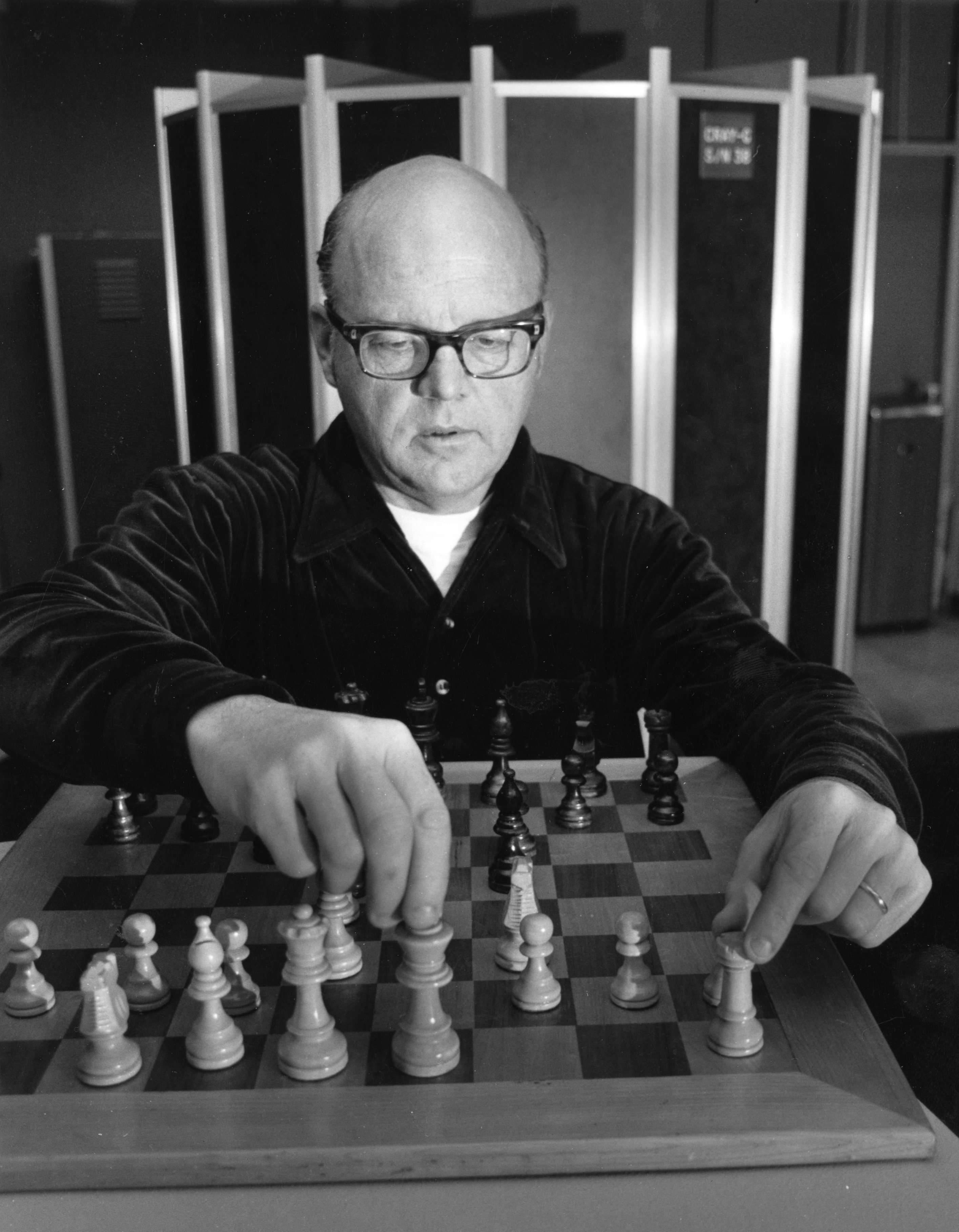
Cray Blitz won the second and third rounds handily but played Nuchess to a draw in the fourth round. However, Bebe beat Nuchess in the fifth, and final, round clinching the victory for Cray Blitz. Nuchess finished in a two-way tie for fourth, and Belle sank to a four-way tie for sixth, making the first place Cray Blitz the only undefeated team.
The following year, as the reigning WCCC holder, Cray Blitz was matched up against David Levy, the international chess master and co-organizer of the first WCCC, in a “man versus machine” match. Levy had famously been competing and winning against computer chess programs since 1968 when he wagered that he could defeat any computer chess program for the next decade—which he did. While Levy declined to renew the wager for another full 10 years because of the progress he saw in computer chess programs, he did extend the gamble for an additional five years.
While Levy had lost some games to computer chess programs since 1978, he had never lost a match. His set against Cray Blitz was the last in the five-year installment of the bet, and it was a match that he handily won, 4-0. While the team of Nelson, Gower, and Hyatt were quite limited by technical issues, indeed losing both the second and third rounds due to hardware failures, Hyatt would later state, “I don’t think we could have won the match, even without the technical problems we had.”
After his 15 years of “man versus machine” dominance, Levy, eager to grow the progress of computer chess development, offered a cash prize to the first program that could beat him. In 1989, the authors of Deep Thought collected when their effort soundly beat Levy.
In June 1986, Harry Nelson and partners returned to the summit of the computer chess world, winning a second consecutive WCCC from a field of 22 challengers with their Cray Blitz program, now run on a Cray XMP-48. The competition was highly competitive with four teams tied for first place; but, on the basis of secondary scoring, Cray Blitz drew one point higher and retained its title.
What made the chess match-ups, particularly the latest victory, interesting for Nelson? Parallel computing. “Our job is to harness the power of its four processors to give it the ability to play chess. Computer chess is a real good example of what you can do in parallel. The first, second, and fourth place teams played on parallel machines. That's the direction of the future—the parallel computer.” Nelson was correct.
While LLNL had been utilizing parallel computers for some time; in 1990, it launched a Laboratory-Directed Research and Development project called the Massively Parallel Computing Initiative (MPCI) to explore the potential of massively parallel computing as the future of high performance computing. The initiative—and comparable efforts at Los Alamos and Sandia national laboratories—paved the way for the Accelerated Simulation and Computing Initiative (ASCI), now NNSA’s Advanced Simulation and Computing program, which is a vitally important backbone of today’s Stockpile Stewardship Program.
For the Cray Blitz team, 1986 was the final year of Cray Blitz’s computer chess dominance. The program was quickly surpassed and beaten by newer, more robust efforts. Robert Hyatt would go on to write other successor chess programs, while LLNL’s Harry Nelson remained active in the North American Computer Chess Championship circuit until it disbanded in 1994. He retired from LLNL around the same time.
— Jeff Sahaida, LLNL archivist