
Browse this site's news, projects, and people highlights via any of the topics in the dropdown list or below each content description.
Select a Topic:
PROJECTS
Vidya
This project advances research in physics-informed ML, invests in validated and explainable ML, creates an advanced data environment, builds ML expertise across the complex, and more.

MAPP
The MAPP incorporates multiple software packages into one integrated code so that multiphysics simulation codes can perform at scale on present and future supercomputers.
PEOPLE

Julian Andrej
Computational mathematician Julian Andrej began using LLNL-developed, open-source software while in Germany. Now at Livermore, he lends his expertise to the Center for Applied Scientific Computing…

Steven Roberts
As Computing’s fifth Fernbach Fellow, postdoctoral researcher Steven Roberts will develop, analyze, and implement new time integration methods.
Stefanie Guenther
Lawrence Livermore National Lab has named Stefanie Guenther as Computing’s fourth Sidney Fernbach Postdoctoral Fellow in the Computing Sciences. This highly competitive fellowship is named after…
NEWS
Workshop highlights new research using finite element methods
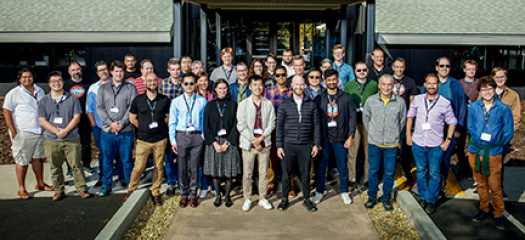
Held for the first time in a hybrid format, the multi-day MFEM workshop drew participants from around the globe.
SC24 event calendar
LLNL is participating in the 36th annual Supercomputing Conference (SC24) in Atlanta on November 17–22, 2024.
Video: HPC tutorials playlist updated for 2024
Follow along at your own pace through tutorials of several open-source HPC software projects.